If you have ever been a bit startled by a barely audible pop or crack during the particularly chilly nights or have seen a broken panel after a winter tempest, then you have personally observed the house’s yearly battle.
Knowing the reason for the occurrence is your initial and strongest protection. Therefore, let us unravel the science, the everyday dangers, and—most importantly—an easy, detailed prevention program.
The reason Cold Weather turns Vinyl Siding into Bayonets:
Thermal Contraction: When it gets cold, vinyl shrinks. A 12-foot span can lose as much as 0.5 inches in length when the temperature changes from a summer day at 70°F to a winter night at 20°F. This, in turn, causes a stable tension on the fasteners and seams throughout the length of the siding.
Loss of Flexibility: At very low temperatures, the vinyl plasticizers that keep it elastic turn less effective. As a result, the material’s flexural modulus increases, which means it becomes stiffer and loses the property of absorbing energy or flexing without breaking.
The Impact Threshold: Vinyl has a very low temperature limit of -20°F, but its impact resistance is greatly reduced. Research indicates that at freezing conditions, it may be up to 70% more susceptible to impacts as compared to room temperature conditions.
The Two Main Types of Cold-Weather Damage
1. Stress Cracks
These are hairline fractures, often starting at nail holes, corners, or cut edges. They’re caused by the repetitive stress of expansion and contraction cycles, not a direct impact.
Where to Look: North-facing walls (coldest exposure), areas near windows and doors, and anywhere the siding movement is restricted.
2. Impact Brittleness & Shattering
This is the most obvious damage. When vinyl is cold and brittle, things that would normally bounce off can cause catastrophic failure.
Common Culprits: Hail, wind-blown branches, ice chunks from roofs, snow blower projectiles, or even errant sports balls.
Your Seasonal Prevention & Maintenance Plan
Proactive prevention is infinitely cheaper than springtime repairs. Follow this seasonal guide to protect your investment.
3. Fall Preparation (Before the First Freeze)
This is the most critical period for action.
Conduct a Thorough Inspection: Walk the perimeter of your home. Look for:
- Loose or rattling panels
- Nails that are driven in too tight (they should have a slight gap)
- Existing cracks or damage
- Poorly secured trim or corners
- Trim Vegetation: Cut back all tree limbs and shrubs that could scrape or whip against the siding in winter winds.
- Ensure Clearance: Verify that siding panels and trim have a small gap (about 1/4 inch) at ends to allow for contraction.
Caring for Your Home during the Winter: “Do Not Disturb” Phase
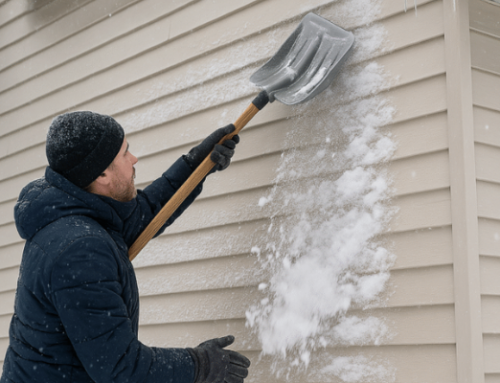
- Snow Removal with a Soft Touch – Both Heavy Snow Build-Up Around Foundation Wells and Corners of Your Home – Use Plastic Shovels
- Ice Dam Removal – DO NOT Chip or Hack Away at Ice Directly Against Your Siding. Use Calcium Chloride Ice Melter to Create Frozen Drainage Channels.
- Winter Recreational Activities – Snow blowers, Roof Rakes and Any Other Type of Recreational Activity Near or Around Your House Can Impact Your Home
- Recovering from Spring Thaw – Inspect your home after its drying stage
- Damage is often visible when materials expand during the thaw season.
- Inspection – Once your temperature reads above 50°F, check your home for damage
Reschedule Panel Replacement During Natural Mild Weather When Siding Can be Removed with Ease.
Winter Siding Maintenance Schedule For Homeowners:
The following reminders should be printed out and placed on the refrigerator door.
- Fall: Inspect for any missing, loose or broken siding panels, dry rotting of wood siding, broken or protruding nails. Report any vegetation that interferes with the siding installation. Inspect all expansion gaps for debris or material build-up.
- Winter: Use plastic tools when removing snow from your home’s siding, do not use any metal tools. Never pressure wash your home’s siding, as doing so will force water behind the panels and cause them to freeze.
- Spring: Assess damages (if any) once your home has thawed, make an assessment of the damage and make necessary repairs to your home during dry, and mild or normal temperature conditions.
Vinyl is a Superior Option:
Properly installed vinyl siding will continue to be effective and require minimal upkeep for cold-weather locations.
Does Not Rot Or Warp: Vinyl is not affected by the expanding and contracting temperatures experienced in most regions, unlike wood which can rot or warp from moisture.
Color Will Not Fade: The color will continue to appear vibrant for many years to come as the colors are baked into the material itself, thus preventing color loss or flaking due to cooler temperatures or ultraviolet light.
Where The Issues Lie In Winter Weather: Improperly installed vinyl siding accounts for more than 90 per cent of winter problems due to incorrect fastener depth and inadequate expansion space in many areas. Using an experienced contractor, who conforms to the current installation codes, minimizes your risk.
Conclusion: Your winter winning strategy
The winter season is a certain fact, but you do not need to experience siding harm in the winter months. The distinction between a home with siding that successfully remains intact during the winter months and those that will need to be repaired does not come from luck; it comes from a proactive thought process as to how you can prepare your home for the coming harsh weather. Vinyl siding isn’t a hard or fixed durability; it is, in fact, a moving, flexible installation that will only perform to the degree that you are prepared to work with it and not against it during the cold months ahead. The following are tips for maintaining your vinyl siding during the winter months:
- Pre-battle readiness checks for your home during the Fall season.
- The engaging rules of engagement for your home during the Winter months.
- As you see the performance report for your vinyl siding during the Spring months, you will need to complete the necessary repairs once the weather warms up again.
Not only does your home’s real weakness come from the failure of your vinyl siding, it also comes from your understanding of how to properly maintain your home, and your consistent routine of maintaining your vinyl siding throughout the course of the four seasons. Understanding your vinyl siding, its characteristics and why it behaves as it does can move you from the position of being a homeowner who merely resides in a home, to one who is actively involved in caring for their home. Let your confidence in preparing your home this winter take the place of your anxiety. That is the greatest victory.